


Exploring the City
Updated: Jul 4, 2021
June 12, 2021
Got up and had breakfast at Peco's Bill--a 1950s style diner (playing American music as well) across the street from my Airbnb. Realized I forgot my phone (!) so I'll have to go back after eating and before the tour starts at 9am. This place reminds me of the restaurant I ate in in Bangkok that attempted a "southern" restaurant feel--they get most of the details down, but something feels...off. Were lava lamps even a thing in the 50s? A sign says "hamburgers with history," but I have a typical Guatemalan breakfast (which even fast food places serve): tostada with eggs and salsa, black beans, cheese and fried plantains.


It always surprises me the way that travel blogs and books describe a city a certain way, and then when I get there, I find very little of it to be true. In this case--chip cards ARE usable here (where they take credit cards), many places DO take credit cards, but fireworks all the time, people saying "buenos dias" all the time...so far those are not the case.
The food is okay here...but much like Colombia, it isn't very spicy like Mexican food. Plantains are almost too sweet. There are two girls at another table drinking beers and margaritas--it is about 8am. Like Atlanta, there are a lot of murals/graffiti and an abandoned train station.
Met up with my tour guide Erwin...and I'm the only one on the tour. Candy, who has been helping me out online scheduling all my tours, is along for the ride. She speaks very little English.
We drive ALL over the city for about four hours. Guatemala City was founded in 1776 by the Spanish and became the capitol in 1779 after Antigua was destroyed by an earthquake in 1773 and it was simply easier to move it than to rebuild. We drove through zone 4, 10 and 11 where a lot of the government buildings are.

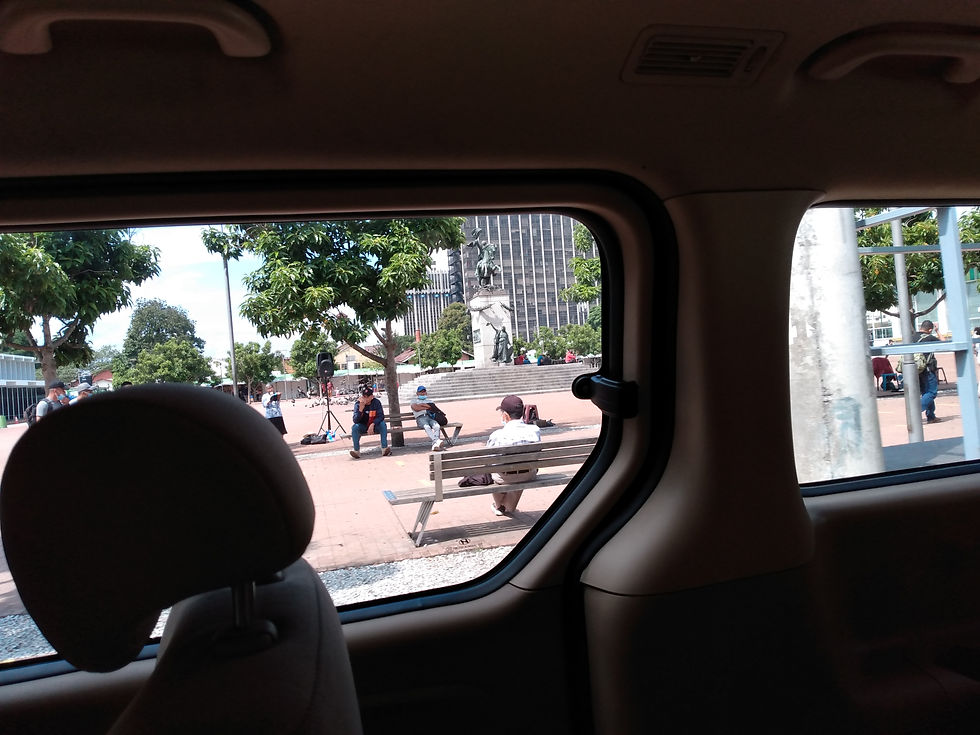
Then we started moving out into the more...sketchy zonas. The main downtown area (zone 5) is around Plaza Barrios, near an abandoned train station which is now a railroad museum. The Plaza is named after Justo Rafeno Barrios, a liberal revolutionary who wanted education for all because it was believed that it was the only way out of poverty (like the liberals of Colombia).


I learn that Guatemala is about 60% indigenous people--which is a HUGE population. There is a group of them referred to as "Ladino" (not Latino), which is an indigenous person who adopts Spanish and makes fun of his old culture. "Indio" is considered a put down of an indigenous person.
They also are very proud of their athletes, even if the government does not support them. A good example is Doroteo Flores who won the Boston marathon in 1952 and was considered a hero--but who died in poverty. There is now a stadium named after him.
The city grows in a spiral starting at Zona 1 in the historic area and growing out into the poverty stricken suburbs...like Colombia. They have nicknamed the TransMetro "gusano" or worm because of the way the green buses look and move (some of them have that middle that moves). Most people not in abject poverty need to make 100-150Q ($15-20 USD) a day to survive--and for most of them, that includes feeding and clothing a family for that as well. As a result, I see (legal) rooms for prostitution, and a TON of street performers--some are more talented than others.
We pass through the neighborhood of Colon in Zona 1--pinatas are huge here and sold everywhere. We stop (briefly) at Cerrito del Carmen--one of the oldest churches (1773) in the city which also features good views of Zona 1. We finally arrive at Mapa en Relieve--a relief map of the city built in 1905 without benefit of modern technology.


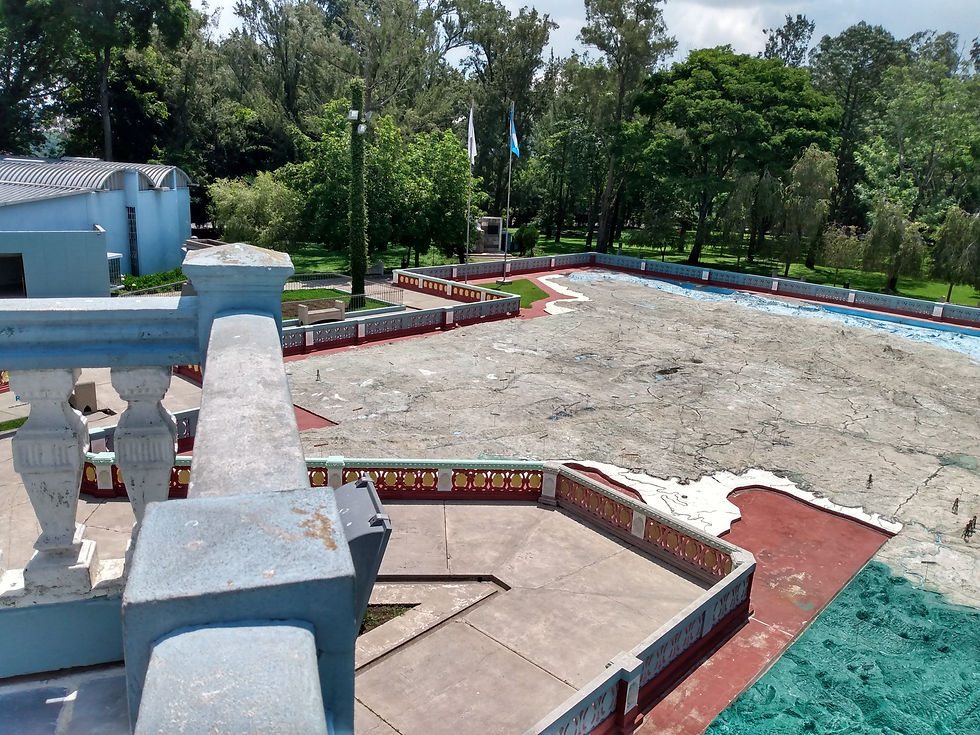


The Relief Map has always been white...but today while we were there, we discovered that it is being painted for the first time ever in color. There are two towers you can climb to get a better look from above--the first one puts you in Mexico, looking out over the country...the other side is Honduras/Belize. They plant trees in their grounds as memorials for marimba makers and players--also the red flowers in the trees are for them. On the street outside were a mobile library, computer lab, and cinema--since folks have been staying at home for over a year it helps get some culture out to them.
We cross a bridge in the northern part of the city in Zona 7 and you can see all the poorer areas in the hills. It is so bad that anti-suicide posters are all over the bridge because people jump from there. From there we head south again and pass by Plaza Berlin (good view of Pacaya Volcano), and the US Embassy (which was sporting a large pride flag out front for Pride month).
Finally, we arrive in Zona 1 and get out of the van to walk around. Parque Central is the hub, and there were some folks out there preaching for Jesus. Around the square are the Cathedral of Guatemala City (1813) and the National Palace (1939-1943, nicknamed El Guacamole for its green color; ruler does not actually live here), and Mercado Central, the largest market in the city, originally built to be a cemetery, and which served as a fort before becoming a market that is underneath the square. I went in to take a look, but it is mostly food--fresh produce, etc. Erwin told me that bartering is so important here because the women are given an "allowance" by their husbands (if they are lucky) and all household stuff--food, clothes, etc) comes out of it so they have to work to get the best prices for things.


After walking around the square, we go into an indoor mall-type place (like they had in Medellin) where we find El Portal--Che Guevara's favorite bar in Guate, and where a who's who of important politicians hold forth. Kind of dive-y, but pretty good size, and features a balcony with a marimba band.


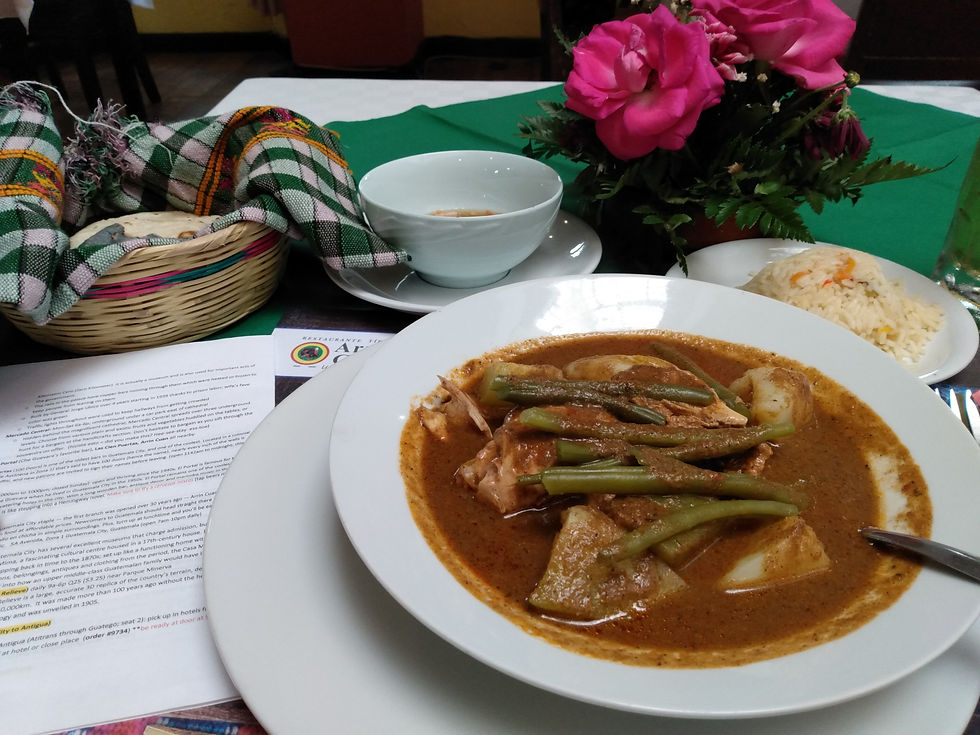
This is where the official tour ends, so I ask Erwin where to find Arrin Cuan--a restaurant that is supposed to feature authentic Guatemalan food. He walks me there and I have some lunch--finally get to try pepian which has an interesting flavor--not spicy, of course, but tasty. It is made with chicken, potato and ground pumpkin seeds along with other spices. It came with a spicy salsa and different kinds of tortillas. This version also had green beans in it. I also had my first Gallo--their national beer--which tastes a lot like Stella.
While I was eating, a marimba band started playing (even though it was only me and one other family in the room).


After lunch, I take what I believe to be the correct route back to my Airbnb on the TransMetro--but as I am discovering, the station names on my map and in the actual stations are sometimes different. Also, I thought that one of the stops where you switch lines would be marked with signs telling you were the other line is...but they aren't. So I had to do a bit of walking around to find it (and discovered Plaza Barrio again while walking). I finally find my bus and head home.

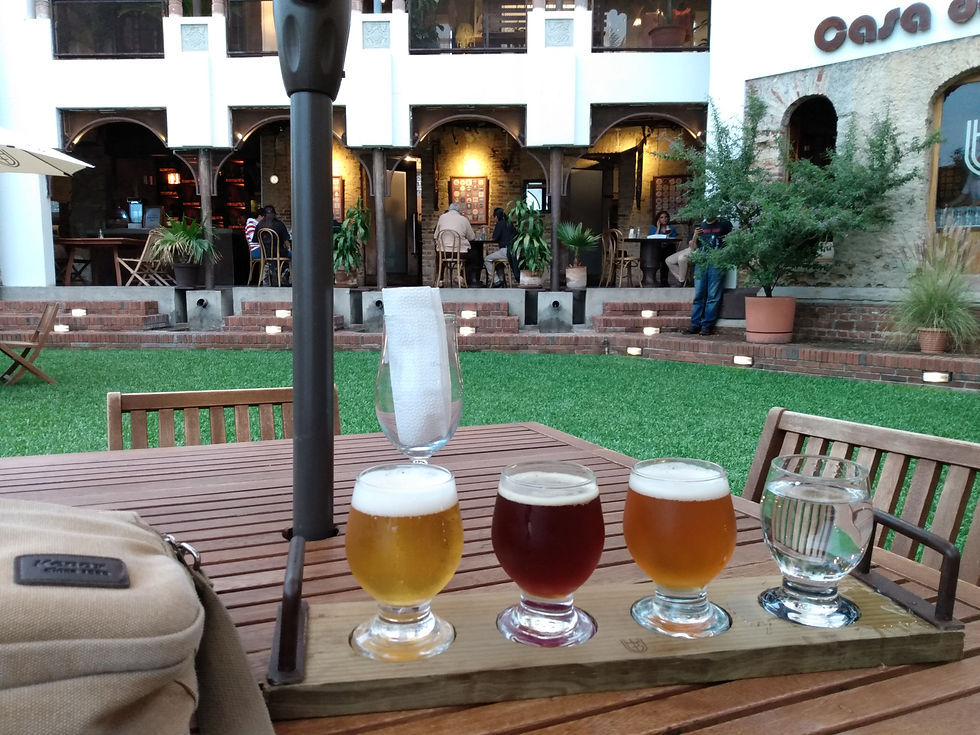
I cleaned up a bit and decided to head out to try some beer at El Principe Gris, a craft brewery around the corner from my building. It was a beautiful building with outdoor seating in a very trendy sort of area. I grabbed a flight of all but one (the IPA of course) of their choices--pilsner lager, lager dunkel, and IPL. While I'm drinking, a waiter asks me how it is and I respond positively, so he says "I bring you eep-ah." Pretty sure I know what he means, and sure enough, he brings me a taster of the IPA. Guess that's what Americans like, right?




Got back to the Airbnb and made some ramen for dinner and did a load of laundry (lots of sweating here)...which doesn't dry despite the fact the machine says "wash and dry." The machine also almost danced away when it started spinning, lol. I had to put everything out on the balcony to dry overnight. While I was writing in my journal (and watching The Simpsons in Spanish), I feel something...odd. I thought maybe it was an earthquake, but it was so fast and not jerky like I expected, so I wrote it off as some light-headedness. I find out a couple of days later that it was, in fact, an earthquake. Good times.


Comments